Arusha, Tanzania | 6 October 2026 The East, Central and Southern Africa Health Community (ECSA-HC)…
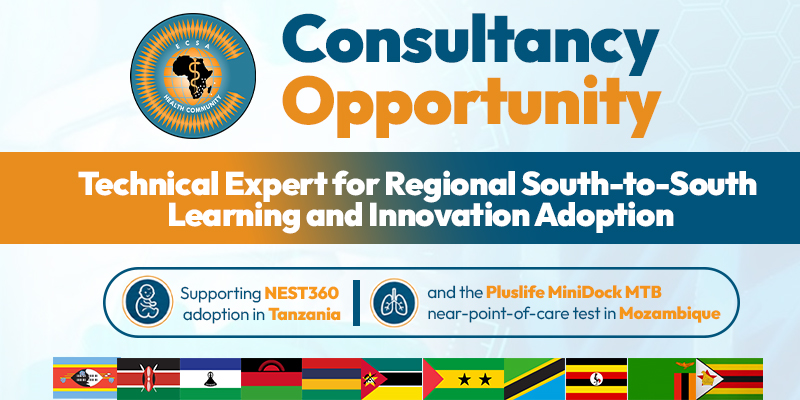
Consultancy Opportunity – Technical Expert for Regional South-to-South Learning and Innovation Adoption
TERMS OF REFERENCE
Technical Expert for Regional South-to-South Learning and Innovation Adoption
NEST360 in Tanzania and the Pluslife MiniDock MTB near-point-of-care test in Mozambique
| Contracting authority | East, Central and Southern Africa Health Community (ECSA-HC) |
| Countries of focus | United Republic of Tanzania and Republic of Mozambique |
| Exemplar/learning partners | Kenya for NEST360; South Africa and Zambia for near-point-of-care TB testing, as applicable |
| Assignment period | As specified in the contract and aligned with the project implementation period through 2028 |
1. Background
ECSA-HC is implementing a regional South-to-South learning initiative to help Member States move from the identification of promising health innovations to their context-appropriate adoption, institutionalization, and scale-up. The initiative brings together ministries of health, technical programmes, implementing partners, experts, and exemplar countries to exchange implementation experience and translate learning into practical country action.
The current phase will support two defined country pathways: (i) Tanzania’s adoption and further institutionalization of the NEST360 health-systems package for quality care of small and sick newborns, informed by implementation experience from Kenya; and (ii) Mozambique’s assessment, introduction, and scale-up planning for the Pluslife MiniDock MTB molecular test as a near-point-of-care tuberculosis diagnostic platform, informed by regional experience, including learning from South Africa and Zambia.
ECSA-HC therefore seeks a Technical Expert to provide implementation-focused assistance across the full adoption pathway—from readiness assessment and adaptation through planning, early implementation, monitoring, financing, and policy integration. The expert will work through national structures, avoid parallel systems, and ensure that all recommendations comply with national policies, regulatory requirements, clinical standards, procurement rules, and quality-assurance arrangements.
2. Purpose of the Assignment
The purpose of the assignment is to provide coordinated technical leadership and hands-on implementation support to ECSA-HC and the two national teams so that South-to-South learning results in feasible, costed, country-owned, and measurable adoption pathways for NEST360 in Tanzania and the Pluslife MiniDock MTB test in Mozambique.
3. Specific Objectives
- Establish a common implementation framework, governance arrangements, and results architecture for the two country adoption pathways.
- Assess country readiness, identify policy and health-system barriers, and define the adaptations required for each innovation.
- Convert learning from exemplar countries and technical partners into country-specific implementation decisions, tools, and action plans.
- Strengthen national capacity in implementation planning, clinical and operational readiness, quality assurance, data use, costing, financing, and scale-up.
- Support integration of the selected innovations into relevant national policies, clinical guidance, annual plans, budgets, procurement systems, and monitoring frameworks.
- Document implementation learning and develop products that ECSA-HC can use to replicate the South-to-South learning model across Member States.
4. Scope of Work
4.1 Inception, governance, and cross-cutting technical support
- Review relevant project documents, workshop outputs, country policies, clinical guidance, programme data, regulatory requirements, and available evidence on both innovations.
- Prepare an inception report setting out the methodology, workplan, stakeholder-engagement approach, country mission schedule, risk register, deliverable calendar, and quality-assurance process.
- Support ECSA-HC to establish or strengthen country technical working arrangements, clarify decision rights, and define the roles of ministries, programme managers, regulators, referral laboratories, facilities, professional bodies, implementing partners, and exemplar-country institutions.
- Develop a harmonized adoption framework covering readiness, acceptability, feasibility, equity, regulatory compliance, clinical effectiveness, workforce capacity, infrastructure, procurement and supply chain, data systems, costing, sustainability, and scale-up.
- Ensure meaningful participation of national and subnational stakeholders and incorporate gender, equity, accessibility, infection prevention and control, and patient safety considerations.
4.2 Tanzania pathway: adoption and institutionalization of NEST360
Working with the Ministry of Health, newborn-health leadership, participating facilities, NEST360 partners, biomedical engineering teams, and Kenyan learning partners, the expert will:
- Conduct a structured readiness and gap assessment for quality care of small and sick newborns, including facility infrastructure, essential technologies, clinical competencies, biomedical engineering and maintenance, oxygen and power systems, infection prevention and control, referral pathways, data systems, leadership, and financing.
- Map Kenya’s implementation experience and identify practices that are transferable to Tanzania, the adaptations required, and assumptions that must be tested locally.
- Support definition of the NEST360 adoption package, including clinical care, context-appropriate technologies, training and mentorship, equipment lifecycle management, quality improvement, and data-for-action components.
- Support selection of implementation or demonstration sites using transparent criteria and develop site-readiness and phased rollout plans.
- Adapt or develop training, mentorship, competency assessment, supportive supervision, equipment maintenance, stock management, and quality-improvement tools in line with national newborn-care standards.
- Strengthen use of facility and programme data, including appropriate use of NEST360 resources such as health-facility assessment tools and the NEST360 Implementation Tracker, subject to national approval and interoperability requirements.
- Define measurable implementation and service-delivery indicators, baselines, targets, data flows, review mechanisms, and feedback loops for continuous improvement.
- Cost the adoption and scale-up pathway and support integration into relevant national and subnational plans, budgets, procurement arrangements, and resource-mobilization efforts.
- Document early implementation experience, identify bottlenecks, facilitate course correction, and prepare a policy and scale-up brief for national decision-makers.
4.3 Mozambique pathway: adoption of the Pluslife MiniDock MTB test
Working with Mozambique’s National Tuberculosis Programme, laboratory and regulatory authorities, provincial and district teams, participating facilities, implementing partners, and relevant learning partners from South Africa and Zambia, the expert will:
- Conduct a diagnostic-network and implementation-readiness assessment covering the target populations, testing gap, current diagnostic algorithm, service-delivery levels, specimen referral, laboratory capacity, infrastructure, power, connectivity, biosafety, workforce, quality management, supply chain, and linkage to treatment.
- Review the applicable evidence and support the nationally required technology-assessment, regulatory, ethical, validation, and approval processes without pre-empting the authority of national or international normative bodies.
- Support national stakeholders to define the intended use case and placement of the platform, including eligibility criteria, testing sites, sputum and/or tongue-swab workflows where nationally approved, referral criteria, result reporting, confirmatory or additional testing, and linkage to care.
- Develop or adapt implementation tools, including site-readiness checklists, standard operating procedures, job aids, training and competency-assessment materials, biosafety procedures, device maintenance plans, adverse-incident reporting, and supervision tools.
- Design quality-assurance arrangements covering internal quality control, external quality assessment or proficiency testing, lot and stock monitoring, data review, corrective action, and escalation pathways.
- Develop commodity quantification, procurement, distribution, inventory, storage, maintenance, waste-management, and resupply arrangements for devices, consumables, controls, and accessories.
- Support design of a phased introduction or implementation study, including site-selection criteria, baseline measures, operational questions, patient-flow mapping, implementation outcomes, risk mitigation, and learning-review cycles.
- Define data requirements and support integration with national laboratory, TB surveillance, and health-information systems, including connectivity, data protection, indicator definitions, reporting timelines, and use of results for programme decisions.
- Undertake costing and budget-impact analysis and develop a sustainable financing and scale-up pathway that considers affordability, total cost of ownership, service volumes, equity, and domestic and partner resources.
- Document implementation lessons and prepare evidence-to-policy products to inform national decisions on continuation, adaptation, procurement, and scale-up.
4.4 South-to-South learning, capacity strengthening, and knowledge translation
- Design and facilitate structured peer-learning exchanges, technical workshops, virtual clinics, facility visits, and after-action reviews with clear learning questions and decision outputs.
- Prepare learning protocols, participant materials, presentation templates, facilitation guides, and action trackers; ensure Portuguese–English technical content is accurately interpreted or translated where required.
- Mentor country champions and ECSA-HC staff in implementation science, innovation appraisal, adaptive management, costing, monitoring, and evidence-to-policy translation.
- Maintain a decision and learning log that records adaptations, unresolved issues, agreed actions, responsible institutions, deadlines, and evidence generated.
- Produce concise case studies, policy briefs, presentations, and technical reports for country leadership, ECSA-HC governance platforms, and the ECSA-HC Best Practices Forum.
- Develop a reusable ECSA-HC South-to-South learning and innovation-adoption package incorporating templates, tools, lessons, and minimum standards from the two pathways.
5. Expected Deliverables and Indicative Timing
Detailed dates will be confirmed in the inception report. Timings below are measured from contract commencement and may be adjusted by ECSA-HC to align with country processes.
| No. | Deliverable | Minimum content | Indicative timing |
| 1 | Inception package | Inception report, detailed workplan, stakeholder map, governance arrangements, engagement plan, risk register, and results framework. | Within 10 working days |
| 2 | Country readiness assessments | Separate validated readiness and gap-assessment reports for Tanzania and Mozambique, including baseline findings and prioritized constraints. | Within 30 working days |
| 3 | South-to-South learning package | Learning agenda, exchange protocols, facilitation materials, decision logs, and concise reports for each learning event. | Before and within 10 working days after each event |
| 4 | Country adoption roadmaps | Two cost-aware, time-bound roadmaps: NEST360 adoption/institutionalization in Tanzania and Pluslife MiniDock MTB introduction in Mozambique, with roles, milestones, risks, and indicators. | Within 45 working days |
| 5 | Implementation toolkits | Country-adapted operational tools, training and mentorship materials, readiness checklists, monitoring tools, and quality-assurance arrangements for each pathway. | As agreed; before implementation |
| 6 | Costing and financing products | Costing, budget-impact and sustainability analyses, with recommendations for integration into plans, budgets, procurement, and resource mobilization. | Within 75 working days |
| 7 | Implementation support reports | Mission or virtual-support reports, updated action tracker, monitoring dashboard, bottleneck analysis, and corrective-action recommendations. | Quarterly and after major missions |
| 8 | Policy and scale-up products | Country-specific policy briefs and scale-up recommendations supported by implementation evidence and stakeholder validation. | Before final project review |
| 9 | Final synthesis and knowledge package | Final technical report, two country case studies, reusable ECSA-HC adoption toolkit, lessons for replication, and presentation of findings. | At assignment completion |
6. Approach and Principles
- Country ownership: national institutions will lead decisions, validation, and integration.
- Evidence and regulatory compliance: recommendations will be evidence-informed and subject to national policy, regulatory, laboratory, ethical, and procurement requirements.
- Systems approach: adoption will address clinical practice, workforce, equipment, infrastructure, maintenance, commodities, financing, data, governance, and quality improvement as an integrated package.
- Learning by doing: implementation will use short feedback cycles, transparent documentation, and course correction.
- Equity and patient safety: site selection and scale-up recommendations will consider underserved populations, access barriers, quality, biosafety, and continuity of care.
- Sustainability: plans will prioritize institutionalization, domestic ownership, total cost of ownership, and use of existing systems.
7. Reporting, Coordination, and Duty Station
The Technical Expert will report to the ECSA-HC Manager responsible for the project, or another designated supervisor, and will work closely with the ECSA-HC project team and designated country focal points. All deliverables will be reviewed and approved by ECSA-HC in consultation with the relevant national authorities.
The assignment will be home-based with travel to Tanzania and Mozambique and, where approved, to Kenya, South Africa, Zambia, or other agreed learning locations. The expert will participate in scheduled coordination meetings and provide timely written updates on progress, decisions required, risks, and mitigation actions.
8. Required Qualifications and Experience
8.1 Academic and professional qualifications
- Advanced university degree (master’s level or higher) in public health, medicine, nursing, biomedical engineering, laboratory sciences, health systems, implementation science, epidemiology, health economics, or a closely related field.
- Relevant professional registration, where applicable. A doctoral degree or additional qualification in implementation science, programme management, health technology assessment, health financing, or quality improvement is an advantage.
8.2 Essential experience
- At least 8 years of progressively responsible experience in health-programme design, implementation, policy support, or health-systems strengthening in low- and middle-income settings.
- Demonstrated experience supporting government-led adoption, introduction, institutionalization, or scale-up of health technologies or service-delivery packages.
- Strong experience in at least one of the two technical domains: quality care for small and sick newborns, including newborn technologies and systems; or TB diagnostics and laboratory-network strengthening, including molecular or near-point-of-care testing.
- Demonstrated ability to coordinate multidisciplinary specialist inputs and apply systems thinking across clinical practice, workforce, infrastructure, equipment, supply chain, data, quality assurance, financing, and governance.
- Experience conducting readiness assessments, developing implementation plans and standard operating tools, establishing monitoring frameworks, and supporting adaptive implementation.
- Experience facilitating South-to-South learning, peer exchange, or multi-country technical cooperation involving ministries of health and regional institutions.
- Experience in costing, budget-impact analysis, procurement or total-cost-of-ownership assessment, and integration of interventions into national plans and budgets.
- Excellent analytical, facilitation, report-writing, and presentation skills, including the ability to translate technical evidence into practical recommendations for senior decision-makers.
- Experience working in East, Central, or Southern Africa and familiarity with government planning, regulatory, and programme-management processes.
8.3 Desirable experience and language
- Direct experience with NEST360 or comparable newborn-care implementation packages.
- Direct experience with the Pluslife MiniDock MTB platform or comparable decentralized molecular TB diagnostics.
- Experience with health technology assessment, implementation research, laboratory quality management, biomedical equipment lifecycle management, or digital health interoperability.
- Fluency in written and spoken English. Working proficiency in Portuguese is highly desirable; where the expert is not proficient, the workplan must include effective collaboration with approved interpretation or translation support.
9. Core Competencies
- Strategic and systems thinking, with strong attention to operational detail.
- Political sensitivity and diplomacy when working across governments, partners, and professional groups.
- Inclusive facilitation, mentorship, and collaborative problem-solving.
- Integrity, independence, confidentiality, and transparent disclosure of potential conflicts of interest.
- Ability to deliver high-quality outputs within agreed timelines and to adapt to changing country needs.
10. Performance Assessment
Performance will be assessed against the quality, timeliness, technical accuracy, usability, and country ownership of deliverables; responsiveness to ECSA-HC and national teams; documented transfer of capacity; effective management of risks and follow-up actions; and evidence of progress from learning to adoption, institutionalization, and scale-up readiness.
11. Confidentiality, Data Protection, and Conflict of Interest
The expert will comply with ECSA-HC and national requirements on confidentiality, research and programme ethics, data protection, information security, and responsible use of programme and patient information. The expert must disclose any actual, potential, or perceived conflict of interest, including relationships with technology manufacturers, suppliers, or implementing partners, and must not make procurement commitments or represent regulatory approval on behalf of any authority.
12.Deadline for Submission
Interested candidates are invited to submit their full applications to: regsec@ecsahc.org and procurement@ecsahc.org
Deadline: 05 Sept 2026– 00:00 hours EAT. All applications should be addressed to:
The Director General
ECSA Health Community
P.O. Box 1009, Arusha, Tanzania
Plot No. 157, Olorien, Njiro Road,
Arusha, Tanzania
Related News