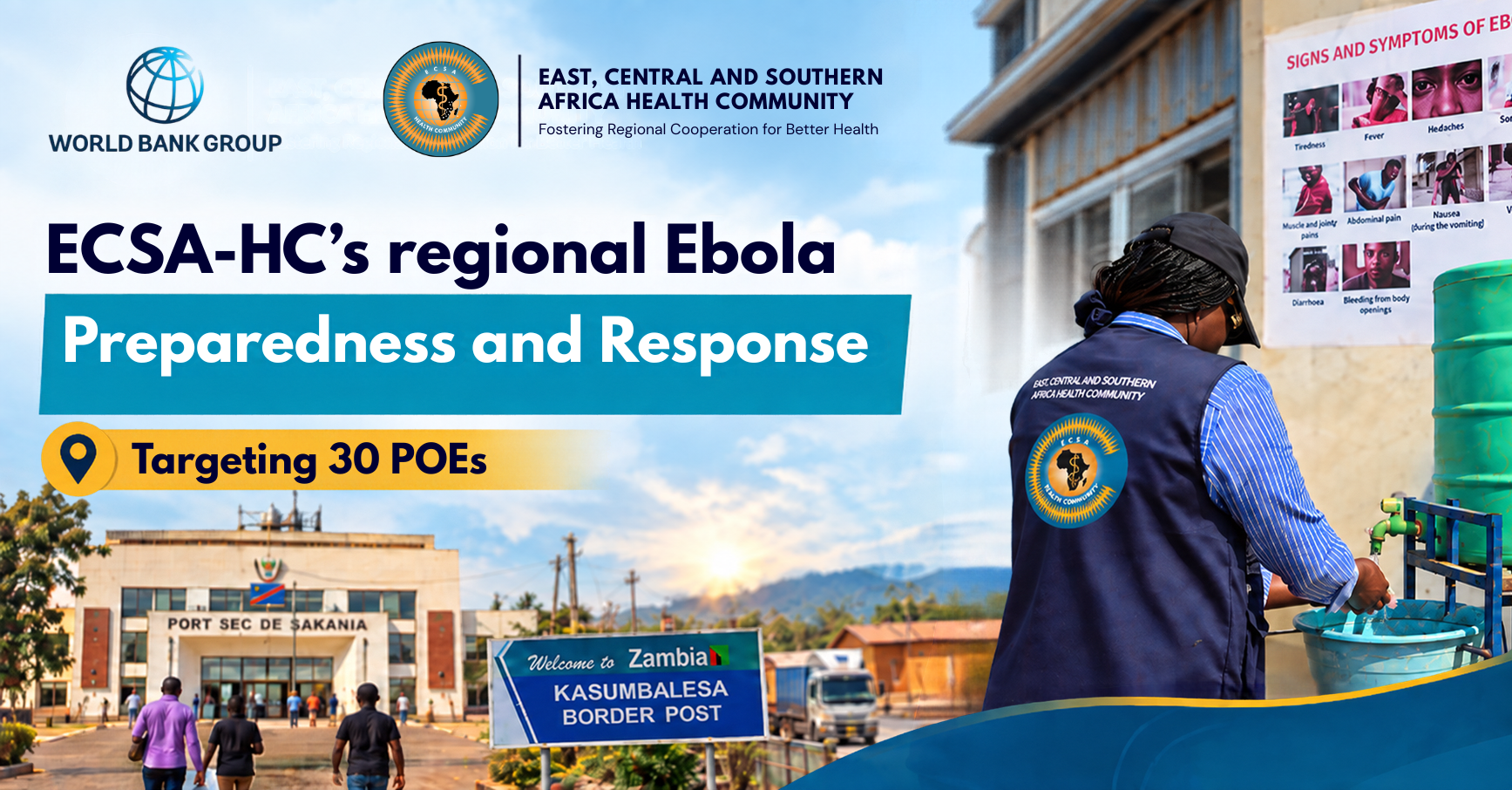
The East, Central and Southern Africa Health Community (ECSA-HC) is implementing a six-month intervention to…
STATEMENT BY THE DIRECTOR GENERAL OF THE EAST, CENTRAL AND SOUTHERN AFRICA HEALTH COMMUNITY (ECSA-HC), DR. NTULI KAPOLOGWE
The official launch of the six-month cross-border Ebola preparedness and response intervention for high-risk Points-of-Entry in Eastern and Southern Africa
Lusaka, Zambia |August 20, 2026.
Today, in Lusaka, Zambia, the East, Central and Southern Africa Health Community (ECSA-HC), has officially launched a comprehensive six-month cross-border Ebola preparedness and response intervention for high-risk borders to the Democratic Republic of Congo (DRC).
Through the World Bank-funded Health Emergency Preparedness, Response and Resilience (HEPRR) Program, this initiative establishes a coordinated front to strengthen high-risk Points of Entry (PoEs) and major transport corridors, leveraging ECSA-HC’s technical teams in collaboration with technical teams and health emergency experts from across our region.
On behalf of ECSA-HC, I extend our deepest, most heartfelt sympathies to the government and people of the Democratic Republic of Congo, as well as all communities across our region affected by this devastating outbreak. We mourn the lives lost, and our thoughts are with the families bearing the weight of this crisis. We also stand in profound awe of and solidarity with the courageous frontline healthcare workers who continue to serve selflessly under immensely difficult conditions. Your sacrifice and resilience remain the foundation of our collective response.
As the second largest and fastest-growing Ebola outbreak in history, the risk of rapid cross-border transmission along high-volume trade and mobility routes connecting the DRC, Uganda, and neighboring Member States is exceptionally high. Infectious diseases do not respect national boundaries, and no single country can secure its population in isolation. Our response systems must be as fluid, interconnected, and responsive as the cross-border movement of the populations we are entrusted to protect.
Through the vital financial support of the World Bank under the HEPRR Program, ECSA-HC is deploying a targeted, standardized seven-point intervention package across 33 key Points of Entry and 16 priority regional corridors. This package is built specifically for high-risk mobile environments including airports, land crossings, river ports, and informal borders, ensuring that frontline teams can detect early, isolate safely, notify rapidly, and refer appropriately.
Over the next six months, our technical teams will focus on executing core operational priorities:
- Baseline Readiness Assessments: Deploying standardized WHO PoE assessment tools to pinpoint operational vulnerabilities and implement immediate, low-cost corrective actions.
- Simulation Exercises and Contingency Planning: Testing cross-border communication chains, referral networks, and port health procedures through functional drills.
- Harmonized Standard Operating Procedures: Streamlining multi-agency workflows across port health, immigration, customs, security, and transport operators for safe screening and referral.
- Event-Based Surveillance (EBS): Equipping frontline personnel and community informants along transit hubs to capture and verify early warning signals.
- Digital Surveillance and 21-Day Tracking: Linking electronic screening at borders directly to district Rapid Response Teams (RRTs) to facilitate traveler follow-up.
- SAFE BORDER IPC/WASH Packages: Enhancing safe triage, hand hygiene, PPE compliance, and decontamination to protect both travelers and border staff.
- Laboratory Readiness and Bio-Safety: Strengthening safe sample collection, triple-packaging, rapid transport chains, and diagnostic linkage to reference laboratories.
- Embedded Regional Coordination: Stationing senior technical epidemiologists within national and regional Incident Management Teams including the Continental IMT in Kampala to ensure real-time data sharing and operational alignment.
By closing critical operational gaps at our borders, this World Bank-supported intervention directly accelerates regional containment strategies and aids our collective drive to curb rising case numbers.
Our firm objective is to build a resilient, interconnected regional defense capable of preventing health threats before they take root in our communities. As we launch this intensive deployment today, we look forward with hope to the day, and may it come very soon, when the last patient is discharged, the transmission chains are broken once and for all, and this outbreak is officially declared over.
ECSA-HC remains fully committed to standing shoulder-to-shoulder with our Member States until that day is realized.
Thank you.
Dr. Ntuli Kapologwe
Director General
East, Central and Southern Africa Health Community (ECSA-HC)
Download full statement by the ECSA-HC Director General, Dr. Ntuli Kapologwe:
STATEMENT-BY-THE-DIRECTOR-GENERAL-OF-THE-EAST.pdf
Related News