




One flight from Entebbe
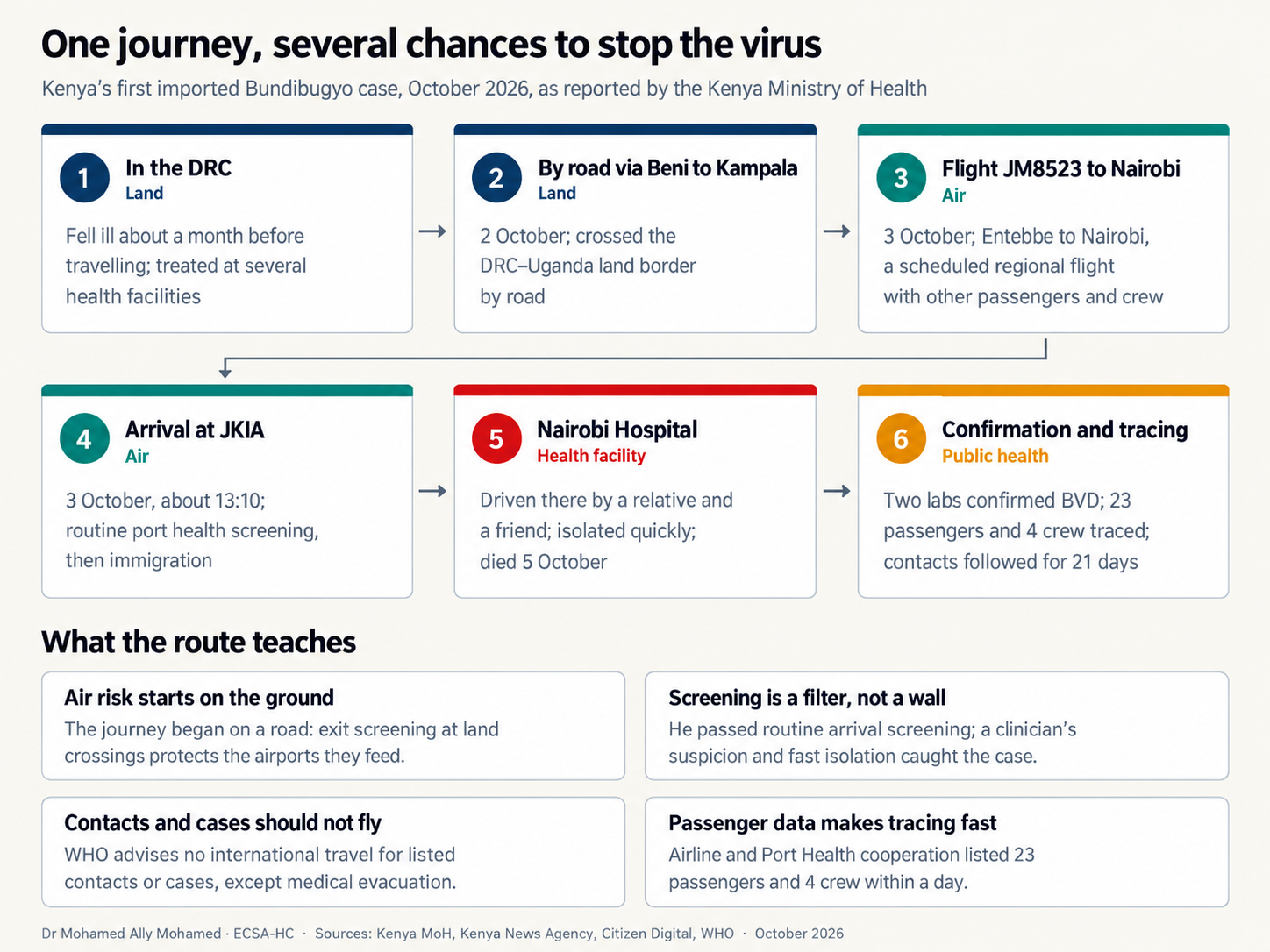
On Saturday 3 October 2026, a Kenyan citizen who had lived in the Democratic Republic of the Congo (DRC) for seven years boarded Jambo jet flight JM8523 from Entebbe to Nairobi. He had fallen ill about a month earlier and been treated at several facilities in the DRC before travelling by road to Kampala.
He went through routine port health screening at Jomo Kenyatta International Airport (JKIA), passed immigration, and was taken by a relative and a friend straight to Nairobi Hospital. Staff isolated him quickly. He died on 5 October, and two laboratories, the National Virology Reference Laboratory and KEMRI, confirmed Bundibugyo virus disease (BVD). Within a day, the Ministry of Health and the airline were tracing 23 passengers and four crew.
That one journey (a land border, a capital city, an aircraft, an airport, a hospital) holds the whole question I want to explore here. How do we keep Africa's skies open, as WHO, ICAO and IATA all advise, while making sure air travel does not become the fastest route for this virus across our region?
Where the outbreak stands
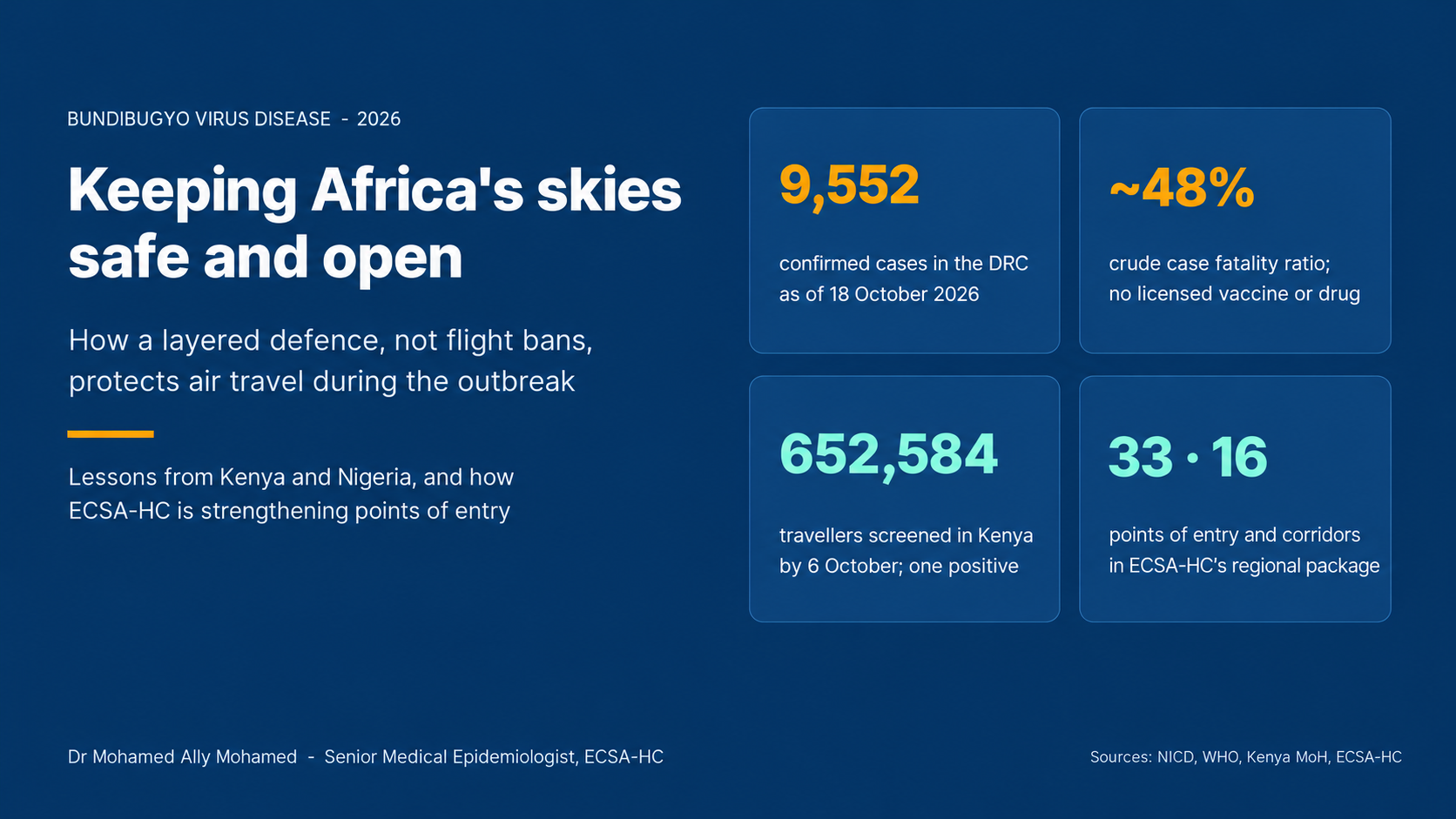
As of 18 October 2026, the DRC had reported 9,552 laboratory-confirmed cases, including 4,602 deaths, across eight provinces The crude case fatality ratio is about 48%, and CDC now describes it as the second-largest Ebola outbreak on record. WHO declared a Public Health Emergency of International Concern on 17 May, and Africa CDC a Public Health Emergency of Continental Security on 18 May. There is still no licensed vaccine or specific treatment for Bundibugyo virus.
Five countries have now detected the virus. Several of those cases reached their destination by air.
| Country | Confirmed cases | How the virus arrived |
| DRC | 9,552 (18 Oct) | Source of the outbreak |
| Uganda | 20, 2 deaths; declared over 27 Aug | Travel from the DRC and onward contacts |
| France | 1, recovered | Responder deployed to the DRC |
| Kenya | 9 (20 Oct) | Road DRC to Kampala, then flight to Nairobi; later cases among his contacts |
| Nigeria | 1 (20 Oct) | Recent travel from Uganda; symptoms began four days after arrival |
Why we shouldn’t close the skies
In May this year, international media reported on suspension of flights to Democratic Republic of Congo as a precautionary measure following confirmation of the Bundibugyo Virus Disease. The instinct to stop flights can be understood, however, there is evidence pointing to why this approach is not encouraged:
- The aircraft cabin is a low-risk setting. Bundibugyo virus spreads through direct contact with the blood or body fluids of a sick person, or with contaminated objects. It is not airborne, and people are not infectious before symptoms begin. IATA’s May 2026 guidance rates the risk of transmission during air travel as very low
- WHO does not recommend bans. Its temporary recommendations say neither flight suspensions nor denial of entry are advised. Instead, affected countries should run exit screening at airports, ports and land crossings, and keep cases and listed contacts off international travel unless it is a medical evacuation.
- Aviation bodies agree. ICAO has urged states and airlines to follow WHO advice strictly and to use tools such as electronic health declarations
- Bans push people underground. WHO warns that closed borders drive travelers and goods to informal crossings that no one monitors. That is exactly where an outbreak is hardest to see.
Screening on arrival far from the outbreak also has limited yield. IATA reminds us that during SARS, Canada screened more than a million arrivals and found no cases. Kenya’s own figure tells the same story: 652,584 travelers screened by 6 October, and one positive. Kenya has stayed open to travel and trade throughout
So, the goal is not fewer flights. It is a safer journey, from the first border crossing to day 21 after landing.
Four lessons from Kenya and Nigeria
- Air risk starts on the ground. The Nairobi patient crossed from the DRC into Uganda by road, through Beni, before he ever saw an airport. An airport is only as safe as the land crossings that feed it. Exit screening at the land border and at Entebbe are two parts of the same defense.
- One checkpoint is a filter, not a wall. He passed routine screening at JKIA. Screening lowers the risk; it never removes it. What saved lives next was a clinician who heard “DRC”, suspected a viral hemorrhagic fever, isolated him and sent a sample.
- Some cases cannot be caught at the airport at all. The Nigerian patient developed symptoms four days after she arrived. With an incubation period of 2 to 21 days, the safety net must extend past the terminal: clear advice to travelers, and clinicians who always ask where a feverish patient has been.
- Good data makes tracing fast. Because the airline worked with Port Health, the Ministry could list 23 passengers and four crew within a day. By 16 October, 127 of 130 contacts were in quarantine with daily checks for 21 days. Kenya’s follow-on cases reported up to 18 October were all detected among contacts already under follow-up, which is the system working as designed
A five-layer defense for air travel
Safe air travel during this outbreak rests on five layers that run from before departure to three weeks after landing. No single layer is enough; together they catch what each one misses.
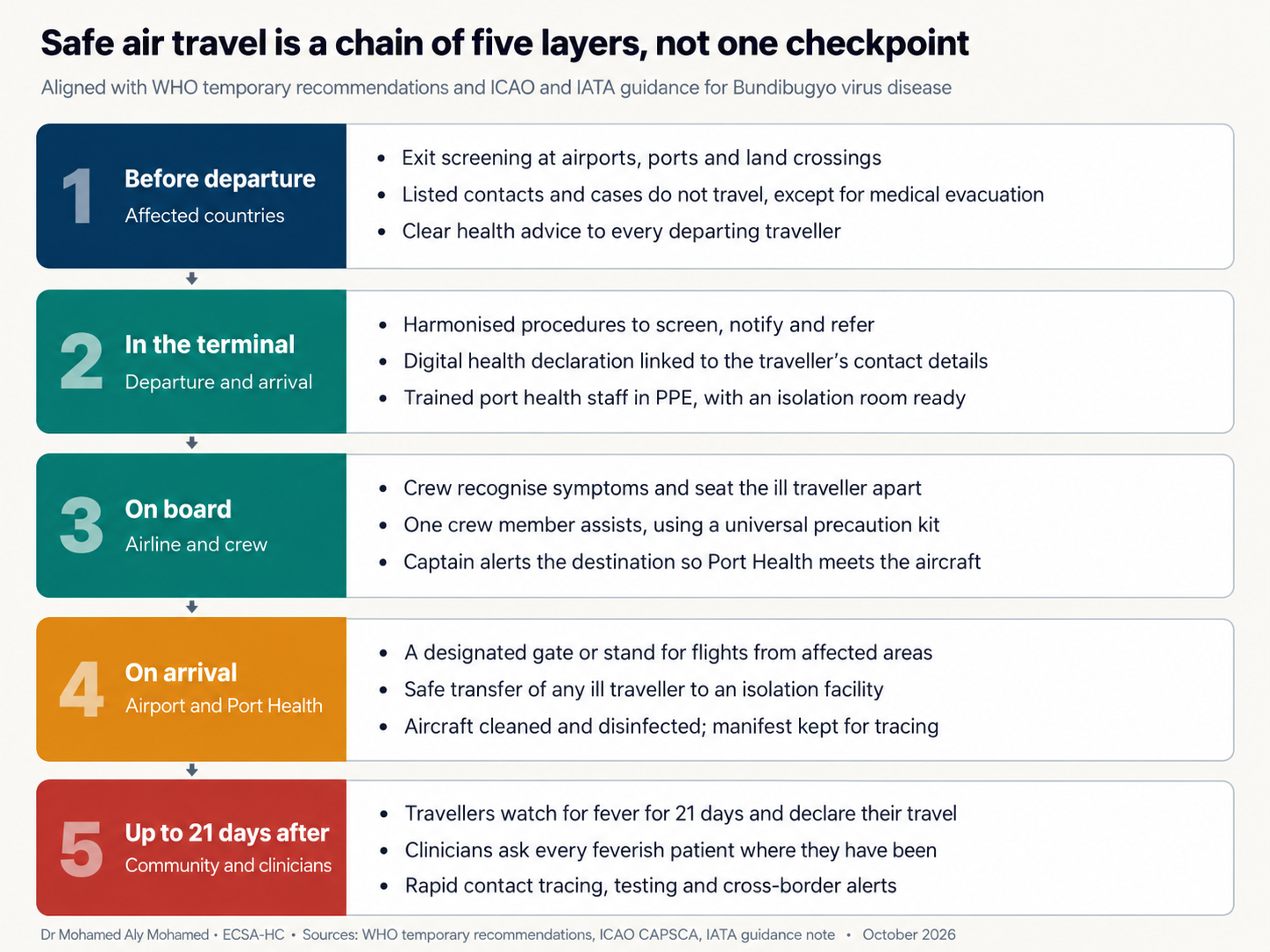
The first and last layers sit outside the airport, and they matter most. Exit screening in affected countries keeps ill travelers and listed contacts off aircraft. Alert clinicians and fast contact tracing catch the cases that incubate past the terminal, as Nigeria’s did.
How ECSA-HC is putting this into practice
At the East, Central and Southern Africa Health Community, we treat airports, land borders and transport corridors as one connected system. Our work since May shows what that looks like on the ground.
- Digital screening Within days of the declaration, ECSA-HC supported Uganda’s Ministry of Health to roll out the Digital Point of Entry Health Screening System: training national trainers and port health staff, deploying the mobile app, and setting up a real-time dashboard Digital records are what make a passenger traceable after landing.
- Joint border assessments Mutukula and Busia Our experts led Uganda and Tanzania through a joint readiness assessment at Mutukula and Kenya and Uganda through another at the Busia One Stop Border Post, using WHO point-of-entry tools. These are the road crossings that feed Entebbe and Nairobi.
- A regional package across 33 points of entry. With World Bank financing through the HEPRR Program, we launched a six-month intervention covering 33 priority points of entry on 16 corridors linking the DRC with Uganda, Rwanda, Burundi, South Sudan, Zambia, Tanzania, Kenya, Angola, Malawi and Mozambique the same seven-point package applies at a land post and at an international airport.
- After the imported case, ECSA-HC joined Kenya’s National Task Force, handed over PPE to the Ministry of Health, and aligned with Africa CDC, WHO, IOM and IGAD. Our team, with experts from Kenya, Tanzania, Mozambique, Zambia and Rwanda, is now working with Port Health at JKIA, Busia and Malaba: the country’s main airport and its two busiest road crossings from Uganda, so air and land entry are strengthened together.
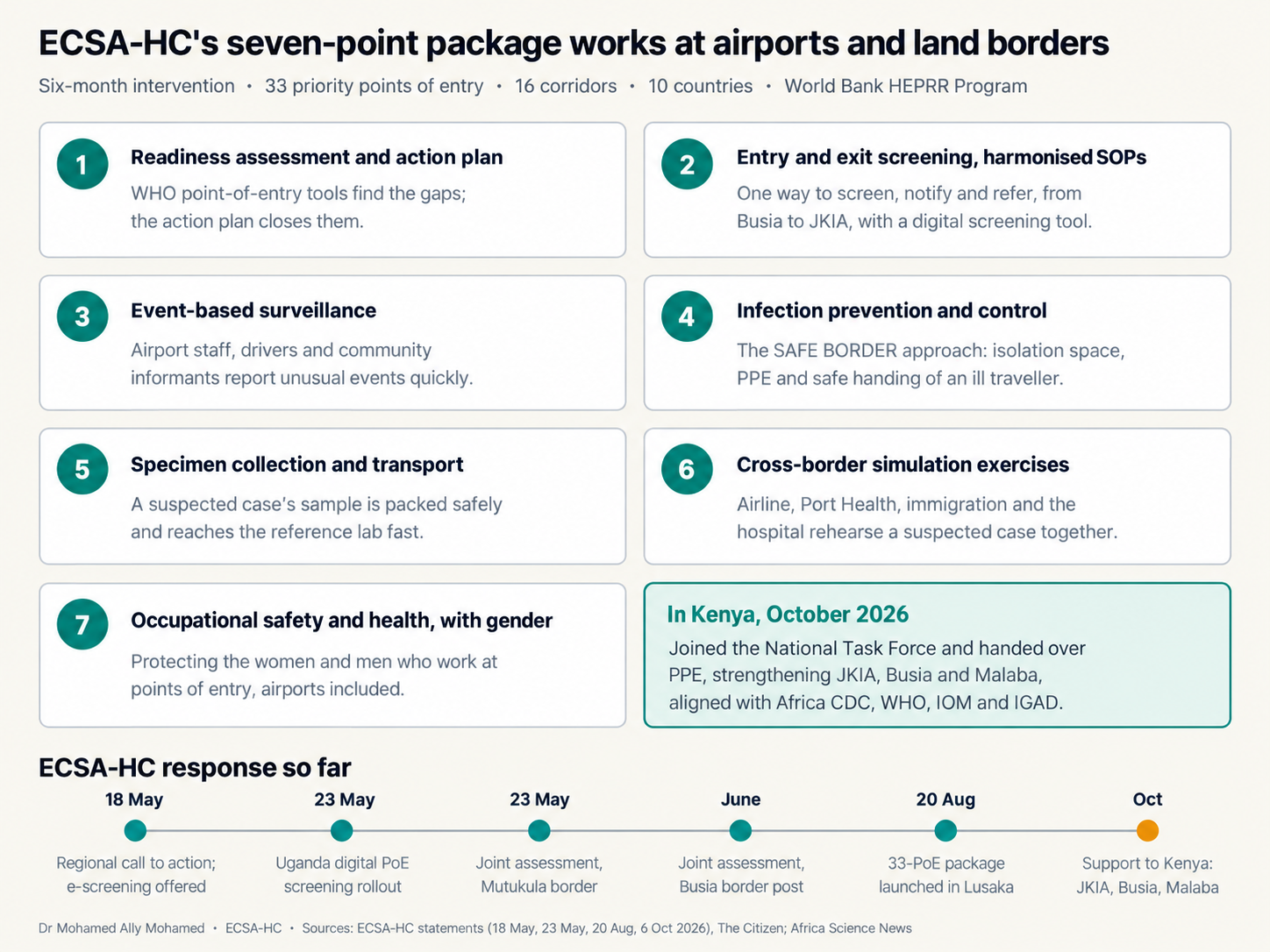
Our assessments are not about finding fault. They find the gaps, and then we stay to build capacity on those gaps, with mentorship and follow-up to track readiness over time.
What each of us can do
- Governments: follow the WHO temporary recommendations rather than bans; fund exit screening at the land crossings that feed regional airports; share contact lists and alerts across borders through IHR focal points within hours, not days.
- Airlines: brief cabin crew on recognizing and isolating an ill traveler; check universal precaution kits on every aircraft serving the region; keep passenger contact details accurate and hand them to Port Health on request.
- Airports: name a stand, an isolation room and an ambulance route for suspected cases; run a joint drill with the airline, Port Health, immigration and the referral hospital before you need it.
- Clinicians: for any fever within 21 days of travel, ask “where have you been?” and isolate first when the answer points to an affected area.
- Travelers: do not fly if you are unwell or have been told you are a contact; give your real phone number on health forms; watch for fever for 21 days and declare your travel when you seek care.
Open skies, safe journeys
Air travel did not cause this outbreak, and grounding it will not end it. What protects passengers, crews and communities is a chain of ordinary, well-practiced actions, each one done properly, from a border post in Ituri to a clinic in Abuja on day 21. Every link we strengthen makes the next imported case smaller.
I would welcome hearing from colleagues in airports, airlines and port health across the region: what is working at your point of entry, and where do you need support?
About the Author