



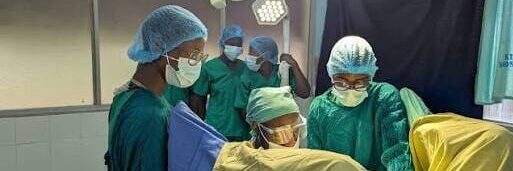

Eleven years ago, the landmark Lancet Commission on Global Surgery (LCoGS) revealed that at least 5 billion people lacked access to safe, timely, and affordable surgical care. The commission also highlighted the enormous mortality associated with inadequate access to surgical care, with millions people dying each year following surgery. The overwhelming majority of this unmet need was concentrated in low- and middle-income countries (LMICs).
But these are not simply historical data. Today, if you go across the East, Central, and Southern Africa region, they remain a daily clinical reality.
An estimated ninety-three percent of the population lacks access to basic surgical services in Sub-Saharan Africa, the region with the world’s most acute surgical gap. And behind this figure lies another demographic truth because our region is uniquely young. Out of those five billion people globally lacking surgical care, an estimated one point seven billion are children and adolescents lack access to surgical care, with the vast majority in LMICs like ours.
Every day, infants born with treatable congenital conditions such as gastroschisis lose their lives or face lifelong disability simply because the facility nearest to them lacks the workforce, equipment, or emergency referral pathways to intervene in time. When a baby receives early surgical treatment, they can achieve a completely normal life, making this gap all the more tragic.
The roots of this crisis are structural, but the burden is unevenly distributed. Across our member states, the shortage of specialist personnel: surgeons, anesthesiologists, obstetricians, gynecologists, ENT specialists, and ophthalmologists remains acute. Where specialists do exist, they are concentrated heavily in urban tertiary centers. This creates a severe urban-rural divide across a region where the vast majority of the population seeks first-line care at primary and district facilities. When rural families do seek emergency or essential surgical care, the economic fallout is often devastating. Out-of-pocket payments push millions of households into catastrophic health expenditure, forcing families to choose between financial ruin and life-saving treatment.
To say nothing has been done would be false. The publication of the LCoGS triggered momentum, leading to World Health Assembly resolutions elevating surgical care and anesthesia as essential components of Universal Health Coverage. Regionally, the East, Central and Southern Africa Health Community Health Ministers passed resolutions to establish regional professional training bodies, “the colleges without walls” such as the colleges of surgeons (COSECSA), anaesthesiologists (CANECSA), and obstetrics and gynaecologists (ECSACOG), and nursing and midwifery (ECSACONM), to complement university system. These institutions have expanded the cadre of certified specialists across the region. Similarly, Member States were urged to prioritize and invest on surgical care and protect pediatric populations. Concurrently,. Nationally, several countries developed and continue to develop National Surgical, Obstetrics, and Anesthesia Plans.
Yet, despite these gains, a critical bottleneck remains. Our rapid population growth continuously outpaces specialist output, effectively neutralizing many of our workforce gains. Furthermore, writing a national plan or passing a regional resolution does not automatically translate into funded hospital beds, functional operating theaters, or sustained supplies of oxygen and anesthesia. Many countries successfully train specialists only to struggle with absorbing them into the health system, leaving newly trained clinicians without the infrastructure, equipment, or institutional backing to perform at their full potential.
If we are to close the surgical gap before another decade passes, we must abandon siloed approaches and adopt a pragmatic, ecosystem-wide strategy. First, we must adopt a balanced model for surgical delivery. While we need specialized centers of excellence for complex pediatric, oncological, and cardiovascular care, we cannot rely on them to solve the population-level burden. We must simultaneously strengthen the capacity of non-specialist medical officers and surgical teams at the district level through targeted training programs. Equipping primary facilities to safely manage basic emergencies and recognize early when to refer decongests tertiary hubs and saves lives.
Second, we must unlock cross-programmatic and innovative financing. Dedicated surgical budgets remain scarce, so ministries of health and development partners must break down funding silos. Existing budget lines for maternal and child health, non-communicable diseases, and oncology can be leveraged to fund shared surgical infrastructure, such as operating theaters, sterilization units, and blood banking systems. Ministries of Health and other ministries in the country, for example the ministry of finance should be able to sit at one table to understand the surgical problems and potential opportunities to address them.
Third, we should deploy regional delivery vehicles and South-South learning models. Synchronized regional medical and surgical camps, led centrally through regional bodies working with national health ministries, serve a dual purpose by clearing massive patient backlogs in underserved areas while facilitating peer-to-peer knowledge exchange among providers.
Finally, we must invest in implementation science and health economics research. Building local research capacity ensures we understand patient pathways, delay factors, and financial barriers, allowing local evidence to directly inform policy and budget allocation. Surgical care is not an isolated luxury or an elective add-on to global health; it is a core pillar of health system resilience. By uniting health ministries, regional colleges, engineers, implementation scientists, health economists, researchers and frontline clinicians around a funded, pragmatic strategy, our region can build a sustainable surgical ecosystem that truly leaves no patient behind.
About the Author