



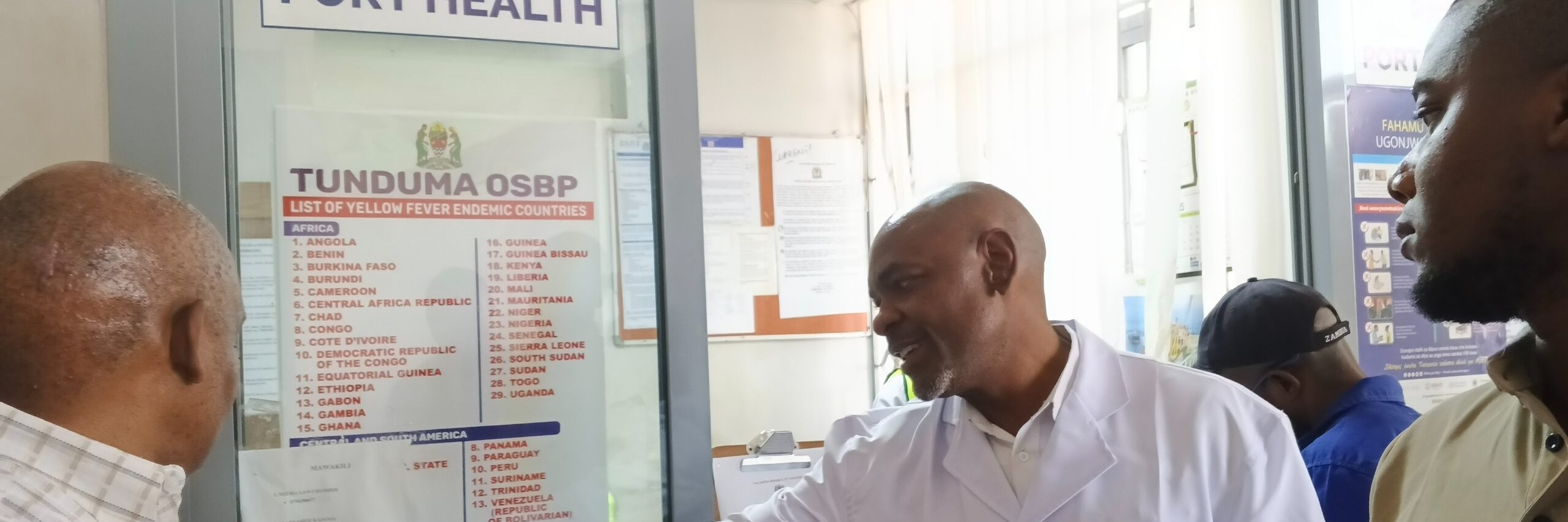

Every day at airports, land borders, and seaports across East, Central, and Southern Africa, a silent but powerful process takes place: data collection. At points of entry such as Kilimanjaro International Airport in Tanzania and across borders in countries like Zambia, Uganda, Kenya, Eswatini, and the Democratic Republic of Congo (DRC), the traveller health information is systematically collected through digital platforms such as “Afyamsafiri” and other national systems. These platforms capture data on symptoms, travel history, and exposure risks. Complementing them, technologies such as thermal scanners which record vital signs like body temperature to enable early detection of infectious diseases. These systems strengthen points of entry surveillance in line with International Health Regulations (2005) and national public health laws. Together, they transform routine border screening into a regional frontline defence for public health. As emphasized by the WHO, timely and transparent sharing of public health data is essential for effective outbreak detection and response (World Health Organization, 2021).
But behind this routine process lies a bigger question: Who really owns this data? And who should benefit from it?
In East, Central, and Southern Africa countries’ borders are highly interconnected through trade, migration, and mobility. Health threats move just as easily as people. This creates a critical tension between data sovereignty: the right of country “A” to control and protect data generated within their borders and the need for global and regional data sharing: the need to rapidly exchange information to detect and respond to outbreaks. For example, an outbreak originating in one country can quickly spread to neighboring countries.Countries in Eastern and Southern Africa face complex, multidimensional cross-border risks that heighten their vulnerability to public health threats. One country is not only at increased risk of importing health threats from neighboring countries but can also serve as a source of such threats to others. This illustrates how interconnected countries in the region are, with cross-border movement amplifying shared risks. According to the World Bank, effective data governance must balance national interests with the global public good (World Bank, 2021).
Scenario from the Frontline
Imagine a traveller arriving in a country; lets name A in East Africa from a neighbouring country with symptoms of a highly infectious disease. Port Health Officers capture and analyse their data immediately, and a potential outbreak health alert is identified. But the decision that follows has regional consequences: if the data is kept strictly within country A, countries in the region may miss critical early warnings; however, if the data is shared openly, there is a risk of exposing sensitive information without guarantees of fairness, protection, or reciprocal benefit. This is not hypothetical; it reflects daily operational realities across African borders. As noted by Seth Berkley, data sharing during outbreaks is both a scientific necessity and a moral obligation (Berkley, 2020).
The solution is not choosing between sovereignty and sharing. It is about achieving ‘Controlled Regional Openness
Why This Matters for East, Central and Southern Africa
For countries in the region, this issue is particularly important because of high cross-border mobility where people, goods, and services move constantly across borders often and informally, making coordinated surveillance essential. Furthermore, shared disease risks mean outbreaks such as Ebola, cholera, and COVID-19 frequently spread across multiple countries, requiring regional coordination. This is complicated by unequal digital capacity where some countries have stronger digital health systems than others, creating imbalances in data generation, access, and use. Finally, there is a risk of unequal benefits, as data generated in African countries is sometimes used globally without ensuring equitable access to resulting benefits such as vaccines, technologies, or insights. The Africa Centres for Disease Control and Prevention emphasizes that Africa must strengthen its data governance to ensure that data generated on the continent benefits its people first (Africa Centres for Disease Control and Prevention, 2022).
Lessons from COVID-19: A Regional Reality Check
The COVID-19 pandemic revealed a critical imbalance: Countries across Africa shared data early and transparently, but access to vaccines and technologies was delayed and unequal. This exposed a key lesson: Data sharing without equity can reinforce both global and regional inequalities. For East, Central, and Southern Africa, this underscores the need for stronger regional coordination and collective negotiation power.
My View: Control First, Collaboration Always (at Regional Level)
From both a frontline and regional perspective, the solution is not choosing between sovereignty and sharing. It is about achieving “Controlled Regional Openness” where countries retain ownership and control of their data, share strategically to protect public health across borders, and ensure fairness, trust, and mutual benefit. This includes sharing anonymized and aggregated data not raw sensitive information, establishing regional data-sharing agreements and protocols, building interoperable digital health systems across countries, and ensuring reciprocity not one-sided data extraction. As highlighted by the Organisation for Economic Co-operation and Development, trust is fundamental and must be built through transparency, accountability, and fairness (Organisation for Economic Co-operation and Development, 2019).
The Way Forward for the Region
To strengthen health security across East, Central, and Southern Africa, countries must invest in regional data governance frameworks (aligned policies and standards), interoperable digital health systems across borders, strong regional institutions and coordination mechanisms, and equitable data partnerships that benefit African populations.
Reflection
Working at the frontline has shown me that data is not just numbers; it represents people, movement, risk, and national sovereignty. In a region as interconnected as East, Central, and Southern Africa, the question is no longer whether to share data, but how to share it responsibly, securely, and equitably. We must not choose between protecting our data or public health. We must do both collectively, intelligently, and ethically.
Disclaimer: The views and opinions expressed in this article are solely those of the author and do not necessarily reflect the official policy, position, or standpoint of the East, Central and Southern Africa Health Community (ECSA-HC), its member states, or its partners. The author has been provided this platform specifically to share a regional frontline perspective on health data.
About the Author