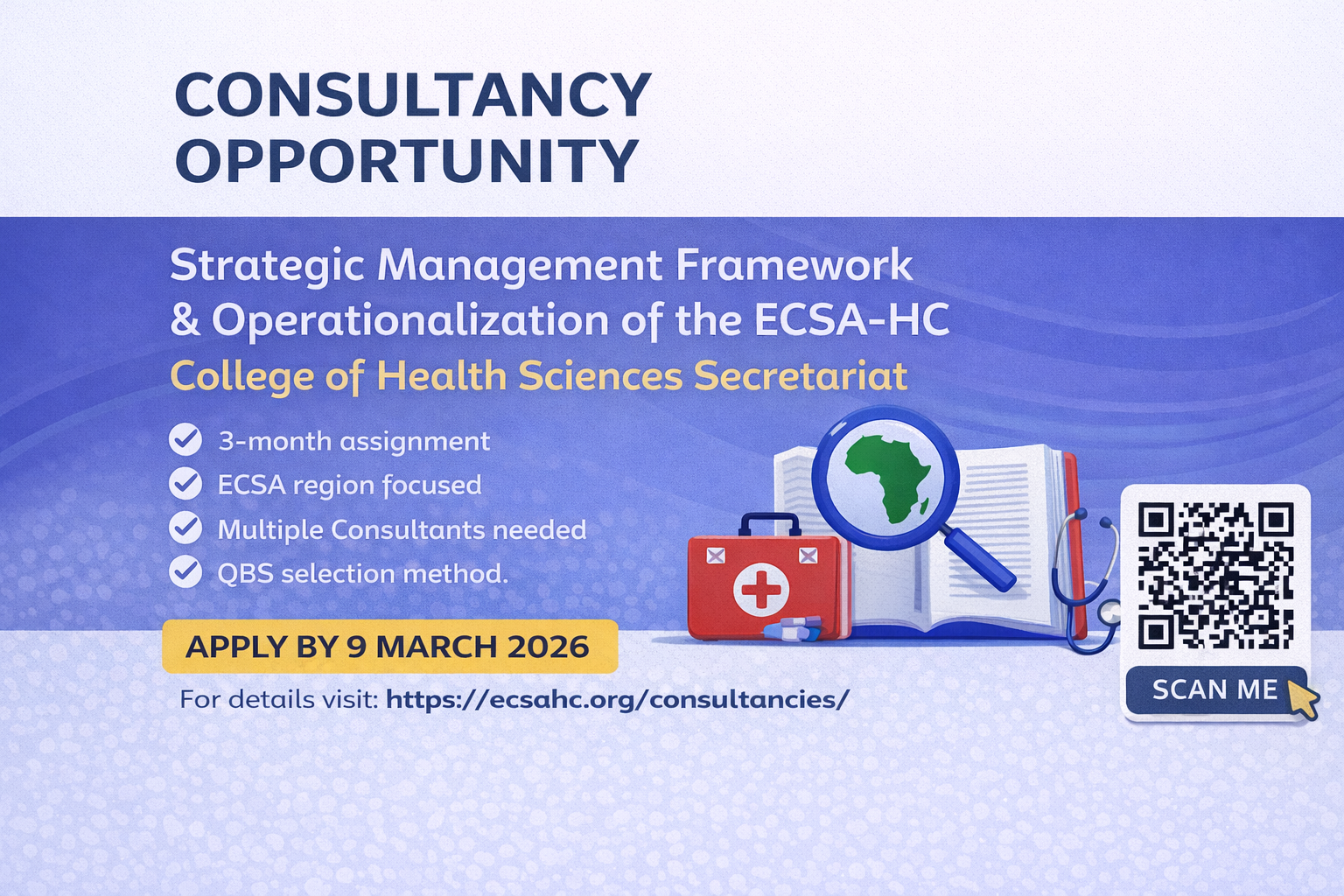
The East, Central and Southern Africa Health Community (ECSA-HC) is pleased to announce a consultancy…
ECSA HEALTH MINISTERS AFFIRM REGIONAL AMR COMMITMENTS AND A CLEAR “PATHWAY TO ABUJA” FOLLOWING THE 76TH HEALTH MINISTERS CONFERENCE IN ESWATINI
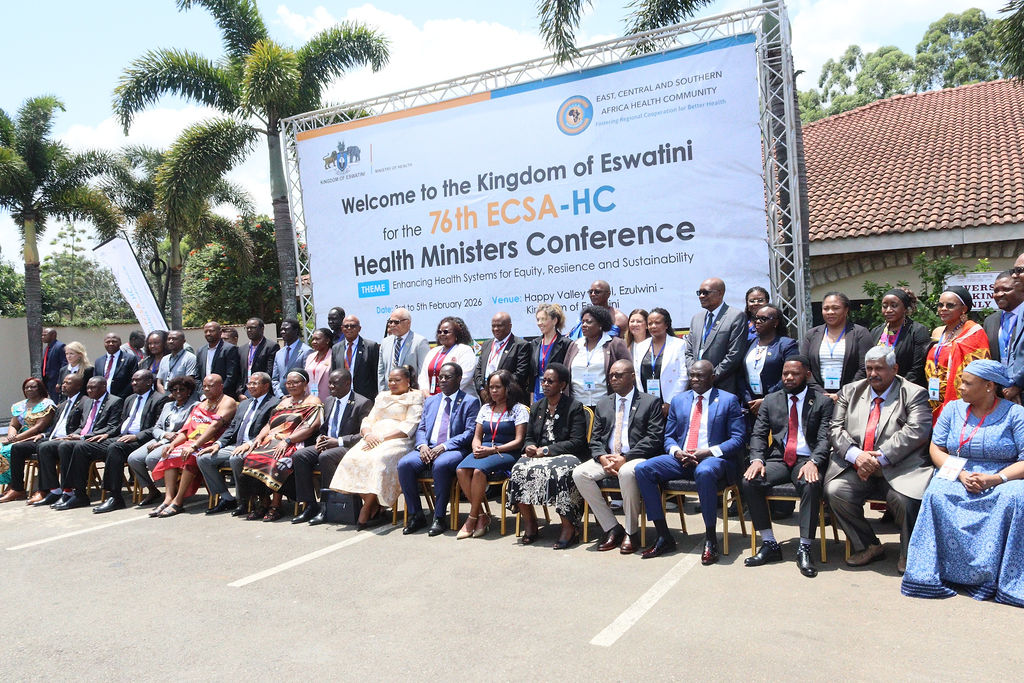
Ezulwini, Eswatini — 05 February, 2026. Health Ministers from the East, Central and Southern Africa (ECSA) region have concluded the 76th Health Ministers Conference with a strengthened, regionally aligned set of commitments to accelerate action on antimicrobial resistance (AMR). The Ministers further reaffirmed a unified regional position and implementation-focused priorities to be advanced at the 5th Global High-Level Ministerial Conference on AMR to be held in Abuja, Nigeria, from 29–30 June 2026. The commitments build on outcomes of the AMR “Pathway to Abuja” pre-conference meeting convened on 2 February 2026 in Ezulwini, Eswatini, which brought together Member States and partners to align priorities, mobilize resources, and generate actionable proposals to inform the ministerial agenda.
In the speech delivered at the 76th ECSA Health Ministers Conference, the Acting Prime Minister of Eswatini, Thulisile Dladla, referred to Antimicrobial Resistance (AMR) as a major threat to regional health security, noting:
Antimicrobial resistance looms as a silent pandemic. These challenges test the resilience of our systems, their ability to prepare for, withstand, and recover from crisis.
The Acting Prime Minister’s call to action served as a catalyst for the conference deliberations, with the Chairman of the Health Ministers Conference, Honourable Mduduzi Matsebula, Minister for Health of the Kingdom of Eswatini, echoed these concerns by emphasizing that such health threats transcend borders. He challenged his peers to move beyond theoretical frameworks toward a unified front of regional solidarity and innovation to safeguard the effectiveness of lifesaving medicines across the ECSA region.
AMR continues to threaten health security, patient safety, and the effectiveness of lifesaving medicines across the ECSA region. Persistent gaps in equitable access to quality-assured antibiotics, laboratory diagnostics, vaccines, surveillance systems, and infection prevention and control (IPC) commodities-combined with underfunded and inconsistently implemented national AMR action plans undermine progress.
Ministers underscored that addressing AMR requires coordinated policies, sustainable financing, stronger stewardship capacity, and accountable leadership across the human, animal, and environmental sectors.
Following deliberations at the Health Ministers Conference and inputs generated through the AMR pre-conference process, Ministers endorsed a practical package of actions structured around four pillars: equitable access to AMR countermeasures; innovative and sustainable financing for AMR National Action Plans (NAPs); sustainable training and education to strengthen antimicrobial stewardship (AMS) and infection prevention and control (IPC) implementation; and political leadership, governance and accountability.
On the specific objectives of the regional roadmap, the Director General of the East, Central and Southern Africa Health Community (ECSA-HC) Dr.Ntuli Kapologwe noted:
“The ‘Pathway to Abuja’ is a critical roadmap for our region. By focusing on equitable access, sustainable financing, and building robust stewardship capacity, we are moving from policy to action, ensuring that every Member State has the tools and accountability needed to combat antimicrobial resistance effectively.”
Ministers committed to advance regionally coordinated solutions to close the access gap, including strengthening availability and appropriate use of quality-assured antimicrobials, laboratory diagnostics, and vaccines. They also highlighted exploring pooled and coordinated approaches to improve purchasing power and promoting local and regional manufacturing where feasible to strengthen supply resilience and affordability. To translate these plans into results, Ministers reaffirmed that sustainable financing is essential, committing to strengthening domestic resource mobilisation and embedding AMR priorities into national budgets and routine financing mechanisms.
Recognizing stewardship as a cornerstone of AMR containment, Ministers committed to strengthen capacity by advancing a regional approach to AMS training and exploring the establishment of an ECSA College of Pharmacists. Furthermore, they emphasized that strong governance is required to sustain action, committing to elevating ministerial oversight and reinforcing high-level governance mechanisms for AMR and related health security priorities.
Supporting this continental alignment, Africa CDC’s One Health Unit Lead, Dr. Yewande Alimi stated:
“The 5th Global Ministerial Meeting on AMR in Abuja is Africa’s moment to shift from commitment to delivery. Regional leadership, including through ECSA, will be essential to turning political commitments into country-level impact, ensuring Africa’s priorities on access, stewardship, and sustainable financing are firmly embedded in the Ministerial outcomes.”
The pathway to Abuja is being advanced in partnership with regional and technical stakeholders, including Africa CDC, WHO AFRO, ICARS, ReAct Africa, and the World Bank. In the lead-up to the June 2026 conference, ECSA-HC will coordinate follow-up technical engagements with Member States to refine commitments and support the integration of agreed actions into national budgets, ensuring the region presents a consolidated ministerial package at the global meeting.
Media contact
Owen Mwandumbya, omwandumbya@ecsahc.org 📱: +255 (0) 763 820 604
☎️ +255-27-2973677/8 🌐: www.ecsahc.org Address: P.O. Box 1009, Arusha, Plot No. 157, Olorien, Njiro Road, Tanzania
Notes to editors
- The AMR “Pathway to Abuja” pre-conference was convened on 2 February 2026 in Ezulwini, Eswatini.
- The 5th Global High-Level Ministerial Conference on AMR will be held in Abuja, Nigeria, from 29–30 June 2026.
Related News