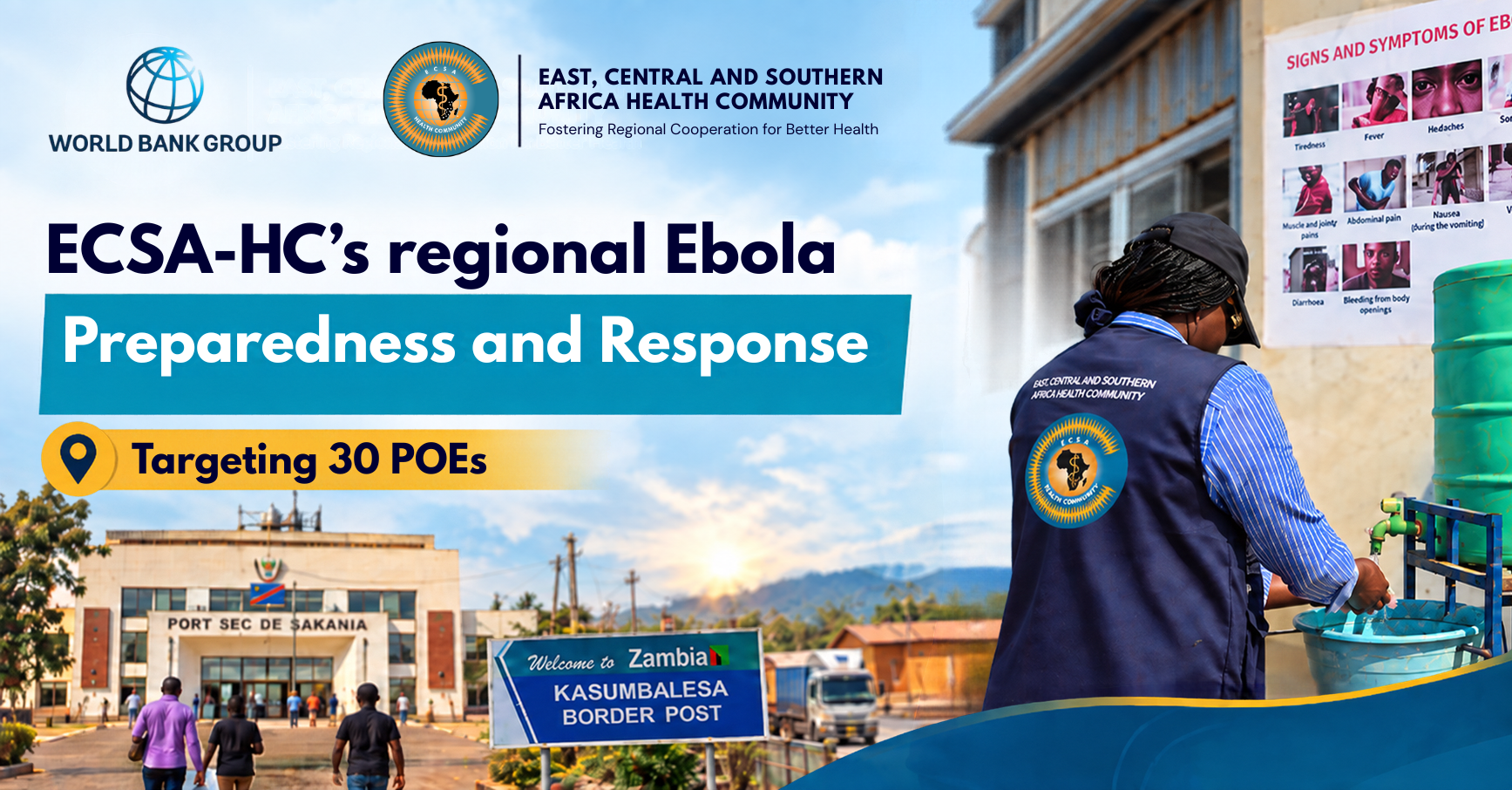
The East, Central and Southern Africa Health Community (ECSA-HC) is implementing a six-month intervention to…
Statement by the Director General East, Central and Southern Africa Health Community (ECSA-HC), On the Release of the WHO GLASS 2025 Report on 13/10/2025
The East, Central and Southern Africa Health Community (ECSA-HC) welcomes the publication of the WHO Global Antimicrobial Resistance and Use Surveillance System (GLASS) Report 2025 — a landmark contribution to global and regional accountability in our collective fight against antimicrobial resistance (AMR).
On behalf of the ECSA-HC Secretariat, I applaud all Member States and the broader African region for their strong commitment to strengthening AMR surveillance, stewardship, and One Health coordination. The progress captured in the GLASS 2025 report reflects years of investment in laboratory capacity, data systems, and cross-sectoral collaboration.
The report highlights encouraging improvements in participation, with 57% of African (27 of 47 countries ) countries now reporting AMR data to WHO a notable increase since 2016. Yet, it also reminds us that less than half of reporting countries have all the core elements of national surveillance systems in place with only 1.3% of laboratories across sub-Saharan Africa designated for bacteriological testing.
The report states that resistance in Africa (19.6%) remains higher than the global average (17.2%). These trends underline the fact that large parts of sub-Saharan Africa still report limited or no data to GLASS, leaving major gaps in regional coverage and indicating persistent inequity in access to diagnostics the urgent need to accelerate access to diagnostics, strengthen infection prevention, and ensure rational antibiotic use.
Resistance was most frequent in the South-East Asia and Eastern Mediterranean regions (almost 1 in 3 infections), followed by the African Region (1 in 5), and less frequent in the European Region (1 in 10) and least frequent in the Western Pacific Region (1 in 11), indicating wide regional disparity showing that AMR is highest where health systems are weakest, underscoring the strong link between resistance, access to care, and universal health coverage. This reinforces the call for greater investments in health system strengthening, sustainable laboratory networks, and integrated One Health surveillance.
ECSA-HC commends WHO, for their leadership and collaboration in this vital work. At the same time, we recognize that more must be done to close critical gaps in surveillance coverage, data quality, and the translation of evidence into action and supports the following Priority Actions for Sub-Saharan Africa which resonate with those identified in the Africa CDC AMR Landmark report 2024.
Investing in prevention first, building capacity for Infection Prevention and Control and Scaling up WASH, scaling up participation and laboratory capacity, using generated AMR data to drive policy and stewardship, building regional capacity through peer-to-peer South–South learning, coordinated via the ECSA-HC Community of Practice on AMR and IPC and expanding One Health surveillance to include animal and environmental sectors for a more complete understanding of resistance dynamics.
ECSA-HC reaffirms its commitment to supporting Member States through technical assistance, joint data reviews, and the promotion of South–South cooperation in line with the WHO GLASS framework. Through our collective effort, we will turn data into decisions, and decisions into sustainable action — protecting health, livelihoods, and the efficacy of life-saving medicines.
We celebrate this report not only as a reflection of progress but as a call to action. Together, we must continue to strengthen surveillance, stewardship, and solidarity ensuring that no country in our region is left behind in the global response to AMR.
Dr. Ntuli A. Kapologwe
Director General
East, Central and Southern Africa Health Community (ECSA-HC)
Related News